
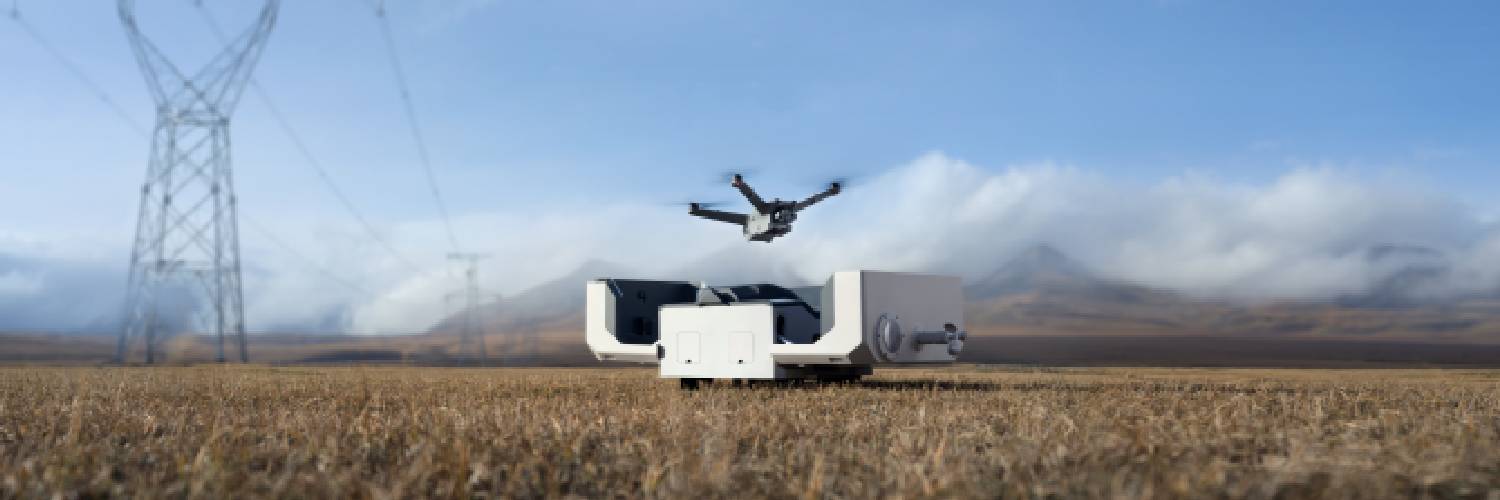
DJI Dock + FlightHub 2 Explained — How Autonomous Drone Operations Actually Work
Autonomous drone systems are often framed as “set and forget.” In reality, successful programs depend on tight integration between hardware autonomy and operational oversight. DJI’s approach pairs docked hardware with a cloud command layer to make this workable at scale.
This article explains how DJI Dock systems integrate with DJI FlightHub 2, what each component is responsible for, and where real operational value is created.


Think of docked operations as two distinct layers:
-
The Physical Layer (Dock + Aircraft)
Handles take-off, landing, charging, storage, and environmental protection. -
The Operational Layer (FlightHub 2)
Handles visibility, coordination, monitoring, auditability, and decision-making.
Neither layer delivers value on its own. Together, they form a usable system.
What the Dock Handles (And What It Doesn’t)
DJI Dock systems are responsible for physical autonomy:
-
Automated launch and recovery
-
Battery charging and thermal management
-
Environmental protection and readiness checks
-
Aircraft storage between missions
This enables drones to fly without a pilot physically present on site.
What the dock does not do:
-
It does not decide when a mission should occur
-
It does not coordinate multiple stakeholders
-
It does not provide organisational visibility
That gap is where FlightHub 2 becomes essential.
What FlightHub 2 Adds to Docked Operations
FlightHub 2 acts as the remote operations console for docked drones.
Centralised Mission Oversight
Operators can:
-
Schedule missions
-
Monitor execution remotely
-
Observe aircraft health and status
-
View live video and telemetry
This transforms docked drones from isolated assets into managed operational resources.
Live Visibility for Stakeholders
FlightHub 2 allows:
-
Operations teams
-
Supervisors
-
Decision-makers
to view the same mission in real time, without needing pilot-level access.
For enterprise and government programs, this shared visibility reduces:
-
Communication delays
-
Misinterpretation of data
-
Dependency on individual operators
Health Monitoring and Exception Handling
Autonomous systems fail quietly if they are not monitored.
FlightHub 2 provides:
-
Automated health checks
-
Mission status alerts
-
Abort and recovery visibility
-
Post-mission logs
This ensures autonomy remains defensible and auditable, not opaque.
Why Docked Operations Without FlightHub 2 Struggle
Running docked drones without a central operations layer introduces friction:
-
No shared operational picture
-
Limited accountability
-
Fragmented communication
-
Reduced confidence in automation
In practice, this leads to:
-
Lower utilisation
-
Manual workarounds
-
Reluctance to scale
FlightHub 2 is what allows dock deployments to move beyond proof-of-concept.
Use Cases Where Dock + FlightHub 2 Excels
The combined system performs best in scenarios where consistency and response time matter:
-
Critical infrastructure monitoring
-
Perimeter security and site surveillance
-
Environmental and asset change detection
-
Remote site validation
-
Post-incident assessment
In these contexts, autonomy reduces on-site labour while FlightHub 2 maintains control and visibility.
Autonomy Still Requires Humans
A critical misconception is that Dock + FlightHub 2 removes operational responsibility.
In reality:
-
Humans still approve missions
-
Humans still interpret data
-
Humans still manage exceptions
What changes is where those humans are located, not whether they are involved.
Autonomy shifts effort from piloting to oversight.
ROI: Where the Value Is Actually Created
The financial return of Dock + FlightHub 2 does not come from flying drones more often.
It comes from:
-
Reduced travel to remote sites
-
Faster response to events
-
Fewer aborted missions
-
More consistent data capture
-
Higher stakeholder confidence
These gains compound as programs scale.
When the Combination Makes Sense (And When It Doesn’t)
Dock + FlightHub 2 Works Best When:
-
Sites are remote or difficult to access
-
Missions are repeatable and predictable
-
Data consistency matters more than flexibility
-
Oversight must be maintained without physical presence
It Is Less Effective When:
-
Missions are highly bespoke
-
Sites change frequently
-
Regulatory approval is limited
-
Operations are single-pilot and ad hoc
Autonomy amplifies structure. Without structure, it amplifies complexity.
MirrorMapper’s Take
DJI Dock provides autonomy. FlightHub 2 provides control.
Together, they form a system that:
-
Reduces operational friction
-
Improves reliability
-
Enables scale
Separately, they are incomplete.
Docked drone programs succeed not because they remove humans, but because they use human oversight more efficiently.


