
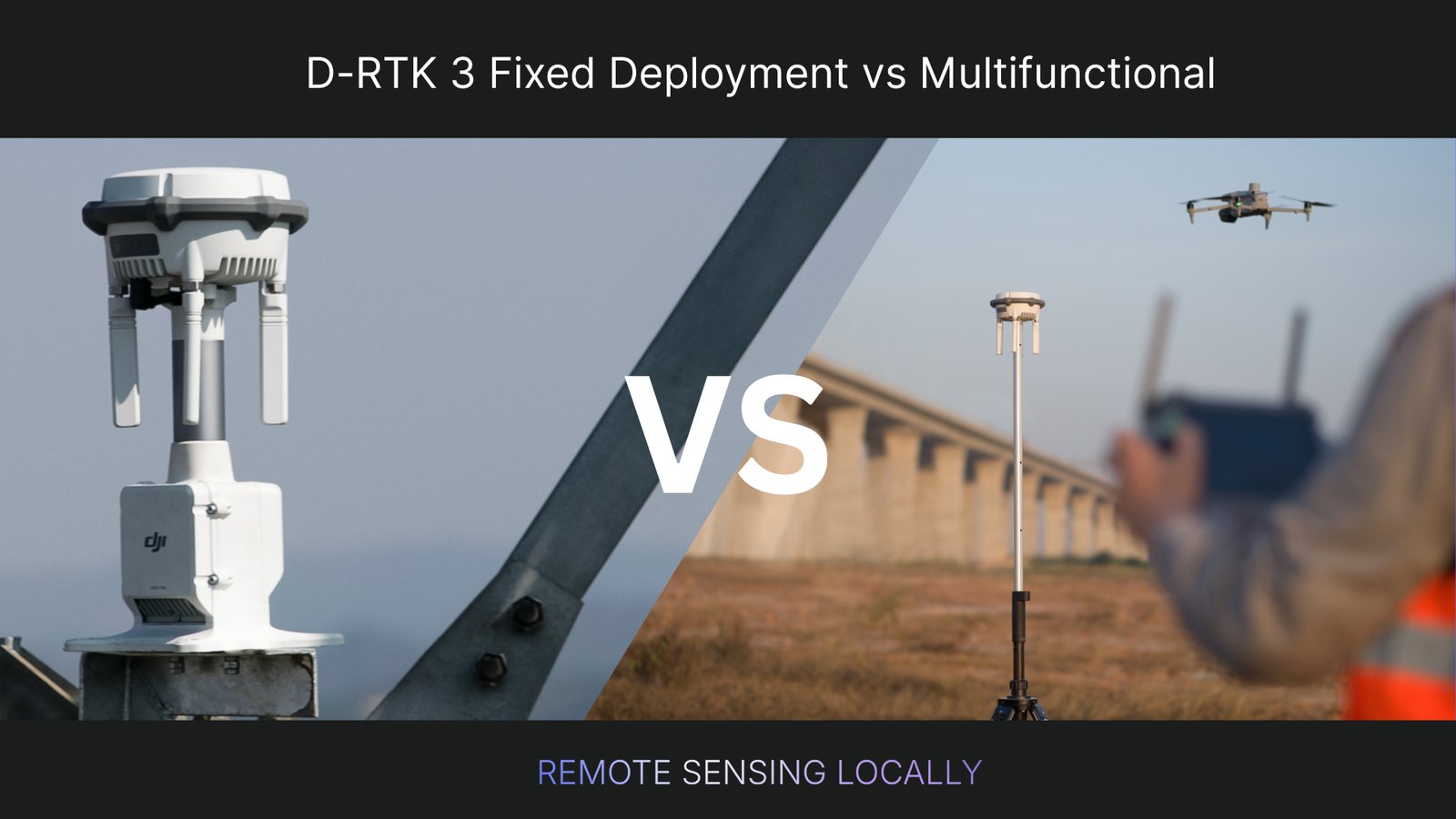
RTK accuracy is only as reliable as the infrastructure supporting it. As DJI’s enterprise operations expand into dock-based, autonomous, and multi-site deployments, the D-RTK 3 platform has been split into two distinct configurations - each designed for very different operational realities.
This article explains the practical differences between the DJI D-RTK 3 Relay Fixed Deployment Version and the DJI D-RTK 3 Multifunctional Station, focusing on how they are used, not just how they’re specified.


D-RTK 3 Comparison
Both deliver centimetre-level positioning. The difference is how and where that accuracy is delivered.
Core Difference: Fixed Infrastructure vs Mobile Accuracy
The D-RTK 3 platform addresses two fundamentally different needs:
-
Persistent accuracy at a fixed location
-
Flexible accuracy wherever the pilot operates
DJI separated these needs intentionally.
D-RTK 3 Relay - Built for Fixed, Autonomous Sites
The Relay (Fixed Deployment) version is designed to operate as permanent RTK infrastructure.
What It’s Designed For
-
Continuous operation at a single site
-
Docked drone systems
-
Autonomous and scheduled missions
-
Long-term installations
Key characteristics:
-
Designed for permanent mounting
-
Continuous power and connectivity
-
Acts as a local RTK relay rather than a portable base
-
Optimised for reliability over flexibility
In practice, this version answers the question:
“How do we guarantee consistent accuracy at this site, every day?”
Where the Relay Version Excels
-
DJI Dock deployments
-
Remote facilities with repeat missions
-
Infrastructure monitoring
-
Environments where GNSS reliability must be predictable
Once installed, the Relay version becomes part of the site, not a piece of field equipment.
D-RTK 3 Multifunctional Station - Built for Mobility
The Multifunctional Station is a portable RTK base station, designed for field deployment.
What It’s Designed For
-
Surveying and mapping projects
-
Mobile inspection work
-
Temporary sites
-
Manual or semi-autonomous operations
Key characteristics:
-
Portable form factor
-
Rapid setup and teardown
-
Supports base, relay, and rover-style workflows
-
Ideal for crews moving between locations
It answers a different question:
“How do we achieve survey-grade accuracy wherever we fly today?”
Where the Multifunctional Station Excels
-
Construction and earthworks
-
Corridor mapping
-
Stockpile and volumetric surveys
-
Projects that change location frequently
It prioritises flexibility and speed of deployment.
Docked Operations Context
RTK requirements change dramatically once drones are docked.
For docked operations, the Relay version is not optional infrastructure - it is foundational.
Accuracy Is the Same. Reliability Is Not.
Both versions deliver centimetre-level RTK accuracy.
The difference lies in:
-
Uptime
-
Environmental hardening
-
Operational continuity
-
Human dependency
The Relay version removes daily setup and human error. The Multifunctional Station accepts those trade-offs in exchange for mobility.
Cost, Utilisation, and ROI
When the Relay Version Makes Sense
-
Docked or semi-autonomous programs
-
Fixed assets with repeat monitoring
-
High cost of mission failure
-
Accuracy must be guaranteed without site visits
When the Multifunctional Station Is the Better Choice
-
Survey teams
-
Short-term projects
-
Changing locations
-
Accuracy needed only during active missions
Buying the wrong version typically results in underutilisation, not accuracy issues.
Mirrormapper’s Take
These two D-RTK 3 variants solve different infrastructure problems.
-
Relay (Fixed Deployment) is RTK as infrastructure
-
Multifunctional Station is RTK as equipment
For autonomous and docked drone programs, RTK reliability is non-negotiable - and portability is irrelevant. For survey teams, the opposite is true.
Choosing correctly reduces operational friction, improves data trust, and prevents expensive retrofits later.


