
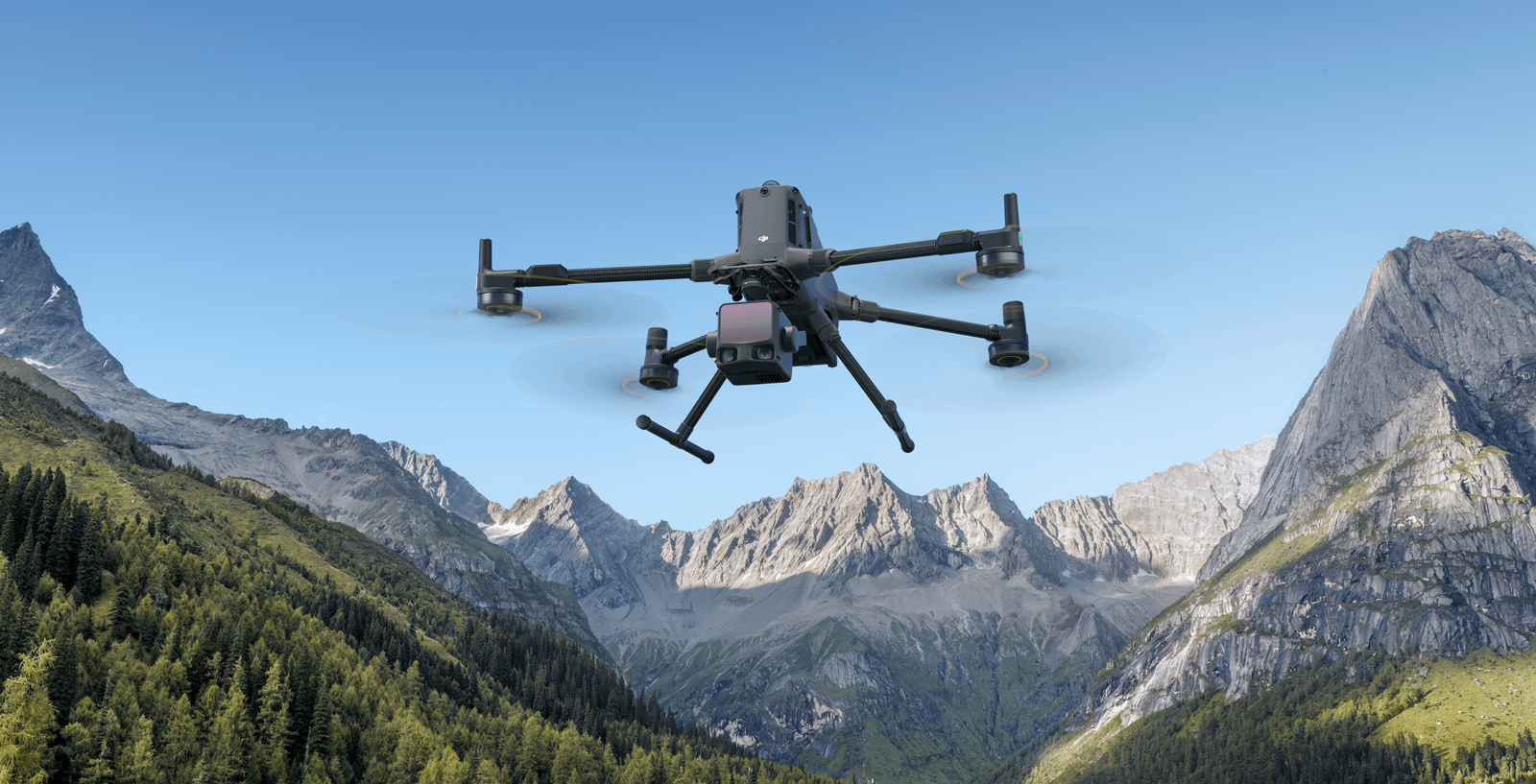
For many enterprise operators, the decision to consider the DJI Matrice 400 starts with a simple question:
“We already run Matrice 350 RTK - what do we actually gain by going bigger?”
This is the right question to ask. The Matrice 400 is not a generational refresh of the DJI Matrice 350 RTK. It is a different class of aircraft, built to solve problems that the M350 cannot - but only when those problems genuinely exist.
This article breaks down where the upgrade is justified, where it isn’t, and how to avoid paying for capability you won’t use.
The Core Difference: Payload Margin, Not Flight Performance
The most important distinction between M350 and M400 is payload margin under real conditions.
Matrice 350 RTK is optimised for:
-
Versatility
-
Rapid deployment
-
Wide payload compatibility
-
Lower operational overhead
Matrice 400 is optimised for:
-
Heavy payload stability
-
Multi-sensor configurations
-
Endurance under load
-
Reduced data degradation from aircraft limits
If your missions are already payload-constrained on the M350, the M400 becomes relevant.
If not, it usually doesn’t.
Payload Reality: Where the M350 Starts to Struggle
The M350 handles most enterprise payloads well - until combinations or mass increase.
Typical stress points:
-
Large LiDAR sensors with high power draw
-
Multi-sensor inspection rigs (RGB + zoom + thermal)
-
Extended hover or slow-speed mapping
-
High-wind environments with heavy payloads
In these scenarios, operators often compensate by:
-
Shortening missions
-
Reducing sensor configurations
-
Accepting lower data consistency
The Matrice 400 exists to remove those compromises — at the cost of increased complexity.
Stability and Data Quality (The Hidden Differentiator)
Flight stability rarely features in marketing comparisons, but it is one of the most important upgrade drivers.
Under heavy load:
-
The M350 prioritises control and safety
-
The M400 prioritises stability and consistency
For workflows like:
-
LiDAR strip alignment
-
High-zoom inspection
-
Precision hover-based data capture
Small improvements in stability can produce disproportionate improvements in data quality.
If your data quality issues originate from aircraft limits rather than sensors, the M400 can be transformative.
Operational Cost and Governance Impact
Upgrading to the M400 is not just a hardware decision.
It introduces:
-
Higher regulatory scrutiny
-
Increased training and competency expectations
-
Greater public risk exposure
-
More formalised governance requirements
The M350 remains easier to:
-
Deploy rapidly
-
Staff across teams
-
Insure and approve
For many organisations, the M350’s operational efficiency outweighs the M400’s raw capability.
Use-Case Comparison
When the Upgrade Is Justified
The Matrice 400 starts to make sense when:
-
Payload mass or power draw limits the M350
-
Data quality degrades under load
-
Missions require multi-sensor configurations
-
Crewed inspections are being seriously evaluated
-
The organisation already operates mature enterprise programs
In these cases, the upgrade can deliver measurable operational and data benefits.
When the Upgrade Is Not Justified
The M400 is often a poor fit when:
-
Payloads are already well within M350 limits
-
Missions are short and flexible
-
Data issues stem from workflow, not aircraft
-
The program lacks governance maturity
In these cases, the M400 increases cost without improving outcomes.
Mirrormapper’s Take
This is not an “old vs new” decision.
-
Matrice 350 RTK is the most efficient enterprise workhorse DJI has built
-
Matrice 400 is a specialist platform for payload-constrained operations
If you cannot clearly articulate why the M350 is limiting your outcomes, the M400 is likely premature.
The strongest Matrice 400 programs upgrade because the data demands it - not because the specs allow it.


