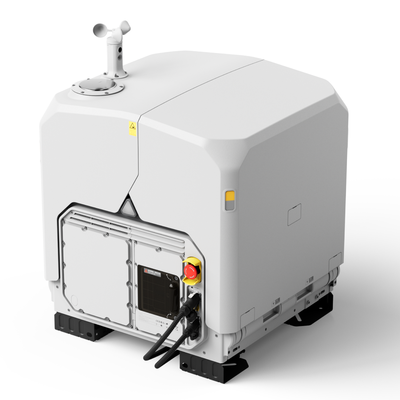
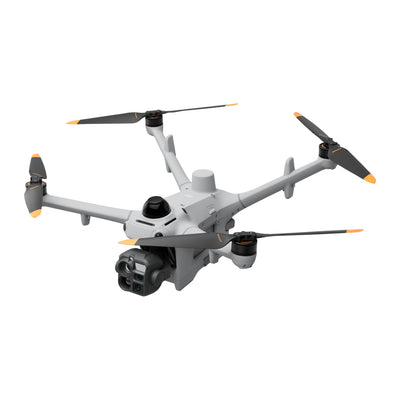
Updated 16 October 2026 from DJI's Dock 4 product intro deck. Dock 4 has one aircraft, the Matrice 5TD, and the dock keeps wireless charging as a backup.
Dock 4 spends the quiet minutes between flights on a battery swap. The aircraft does not wait on a charge, because the dock charges the spare packs while it flies. The next launch waits on the mechanism, not on a full pack. The downtime stays as low as a pack change.
What is in the dock
DJI's Dock 4 product intro deck of 13 October has the figures the teaser left out. A fresh battery is in place under 25 seconds after the cover closes, and the aircraft can launch again in under 45. DJI opened orders on 14 October, and an Australian date is still unannounced. The teaser that ran with this post is a cutaway of the bay with a flight battery in the pad. Its line, 0-Second Battery Swap, is art, not a time.
The pad, with a compartment of four bays that changes the flight battery. Three hold charged packs, two charge at a time, and one bay stays free for the pack coming off. Wireless charging stays in the dock as a backup.
The aircraft that lives in it is the Matrice 5TD, the only aircraft DJI lists for Dock 4, with visual and thermal cameras on one airframe. We quote the dock and the aircraft together.
Room on the aircraft for more than one payload. The Accessory Mount puts the AS2 Speaker and AL2 Spotlight on either side, so both fly together, and the AP1 Parachute takes the top mount.
Less room in the shell than Dock 3, because the swap mechanism takes it. A third-party kit that carries several payloads at once sits outside that bay. WindRise version 1 is that external mount. We sat with the hardware in Shenzhen in May. That photo is the mount on a dock airframe, not a rule for every payload.
What a short gap is for
Security on a yard fails in the quiet. A charge window is a hole in the orbit: the aircraft is home, the fence line is unwatched, and the next pass starts when the pack allows it. A swap puts the aircraft back out while the pattern is still warm.
Bird scaring over a crop has the same shape. A long gap is time the flock uses. They settle, feed and treat the last pass as finished. Scaring works when the next pass is airborne before they decide the paddock is theirs again.
Inspection, a perimeter, a block of crop: the route keeps its place in the day because the pad is not parked on a charger. The aircraft comes home, the pack changes, and it leaves on the same task.
LiDAR in the Matrice 5TD's obstacle sensing is there so the aircraft can work close to the asset, then come home for a fresh pack. Photos of a grey airframe have been public since late July.
Talk through the job if the gap between flights has to stay as short as a battery change. Contact.