When a Dock 3 aircraft lands low, the next flight waits on the charger. DJI's figure for wireless charging from 15 to 95 per cent at 25 °C is 27 minutes. On a patrol roster or an alarm call-out, that is 27 minutes with nothing in the air.
DJI Dock 4 swaps the battery instead. The figures here come from DJI's Dock 4 product intro deck of 13 October 2026, read against the Dock 3 column on the same slides, and we have not tested any of them. DJI opened orders on 14 October and says overseas shipping starts on 28 October, with no local release date yet.
A battery swap in place of the charge wait
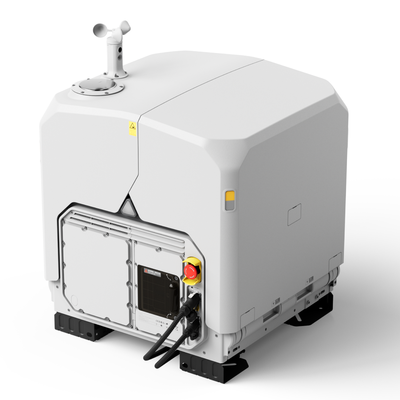
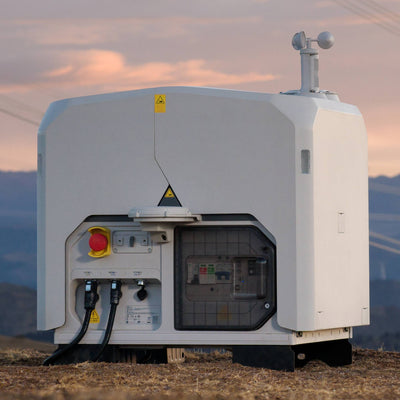
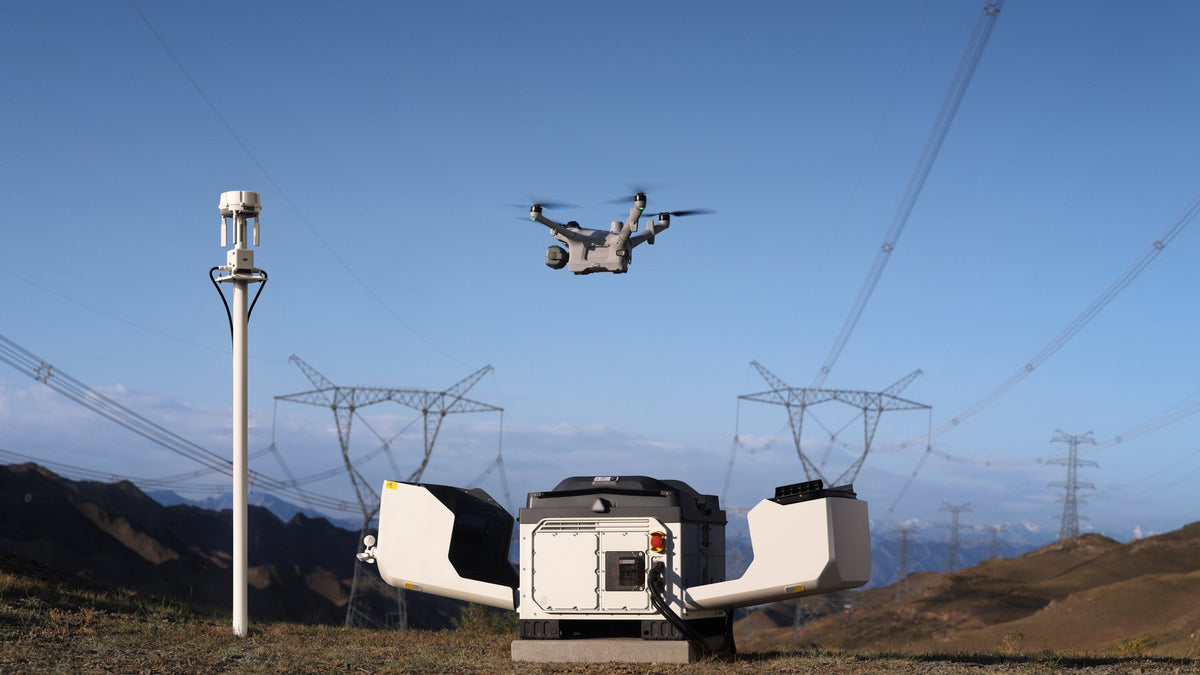
Dock 4 has a sector-shaped battery compartment with four bays. Three hold charged batteries and one stays empty for the pack coming off the aircraft. After landing, a swap arm pulls the depleted battery, rotates, places it in the empty bay and inserts a fresh one. DJI quotes under 25 seconds from the cover closing to the new battery going in, and under 45 seconds before the aircraft can launch again. DJI's deck cites Wikwemikong in Ontario flying 17 missions in one day from a single Dock 4.
Charging still takes 27 minutes from 15 to 95 per cent, two batteries at a time, but now it happens while the aircraft is flying. In standby the dock holds every battery at 95 per cent. A swap runs when the aircraft lands, before an operation starts or an hour before a scheduled mission, and only if the best battery in the compartment is above 90 per cent and more than 10 points ahead of the one in the aircraft. Wireless charging stays in the dock as a backup. DJI says it takes two hours to bring a battery back to 95 per cent that way.
Dock 3 has a built-in backup battery. On Dock 4 the compartment batteries are the backup, and DJI says the dock can still swap and launch after a mains failure while it holds more than two of them.
Media comes off during the same stop. Over Wi-Fi the aircraft sends video files larger than 2 GB at up to 80 MB/s and other media at 40 MB/s, and DJI puts the total at about 2 GB per swap. Full-speed sync for every file type is on DJI's firmware list for January 2027.
RTK and the radio move to the O4 Ground Station
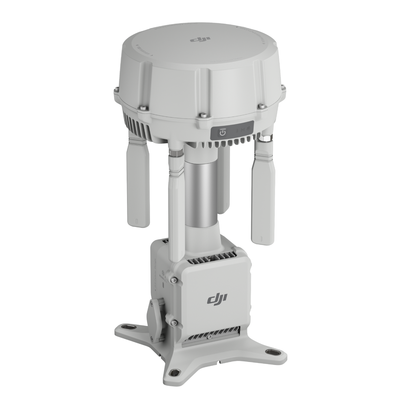
Dock 3 has its RTK base station built in. On Dock 4 the RTK base sits in the DJI O4 Ground Station with the O4 video link, and the O4 is required: a Dock 3 RTK module does not carry over. The O4 runs on PoE over a cable under 80 m, so it can go up a pole or onto a roof, clear of whatever blocks the dock at ground level. DJI's setup calibrates it from the same Custom Network RTK source as the dock, with identical settings.
A second O4 lets the aircraft roam, handing over to the nearest ground station in flight. Roaming has to be switched on before take-off, and each O4 serves one aircraft at a time.
The video link has more paths as well. Dock 4 builds in dual 4G, and DJI suggests a SIM from each of two carriers. Link fusion combines the O4 and both 4G links so a single dropout does not cut the stream. The aircraft encodes video as H.265 and the dock and O4 relay it without re-encoding, which DJI puts at 160 ms from sky to screen.
Dock 3 and Dock 4 side by side
| Dock 3 | Dock 4 | |
|---|---|---|
| Charging | Wireless | Battery swap, wireless as backup |
| Battery swap | Not applicable | Under 25 s |
| Turnaround | Not applicable | Under 45 s |
| Batteries in the compartment | Not applicable | Up to 3, in four bays |
| Backup power | Built-in backup battery | Compartment batteries |
| RTK base station | Built into the dock | O4 Ground Station |
| Operating temperature | -30 to 50 °C | -40 to 50 °C |
| Max operating altitude | 4,500 m | 5,000 m |
| Max input power | 800 W | 2,000 W |
| Weight | 55 kg | 66 kg |
| Aircraft | Matrice 4D or 4TD | Matrice 5TD |
Both docks are rated IP56, take a 12 m/s landing wind and use compressor air conditioning. Weights exclude the aircraft, and the Dock 4 figure also excludes the compartment batteries.
Power, weight and the concrete base
Power is the line to plan around. The spec matrix says 2,000 W maximum, the install slide says 2,200 W and the deployment slide asks for a supply above 2,200 W, against 800 W for Dock 3. DJI Power 1000 mini is not supported, and the power cable moves from LP20 to LP25, so Dock 3 cables do not fit.
Some of a Dock 3 site carries over. Production Dock 4 units use the Dock 3 mounting holes, so the concrete base can stay. At 66 kg the dock is a two-person lift, and it stands 691 mm high without the weather gauge, 66 mm taller than Dock 3. Check the vehicle before install day.
Where each dock fits
Dock 4 suits sites where the aircraft has to go straight back up: patrols, alarm response, repeat inspections through a shift and cold sites down to -40 °C. Dock 3 keeps the lighter install, with an 800 W supply and RTK inside the box, and it flies the Matrice 4D, which has a mechanical shutter for mapping. The Matrice 5TD that flies from Dock 4 has its own list of changes over the Matrice 4TD, covered in our Matrice 5TD comparison.
Send us the site plan, the power available at the pad and how often the aircraft has to fly, and talk through the job with us.